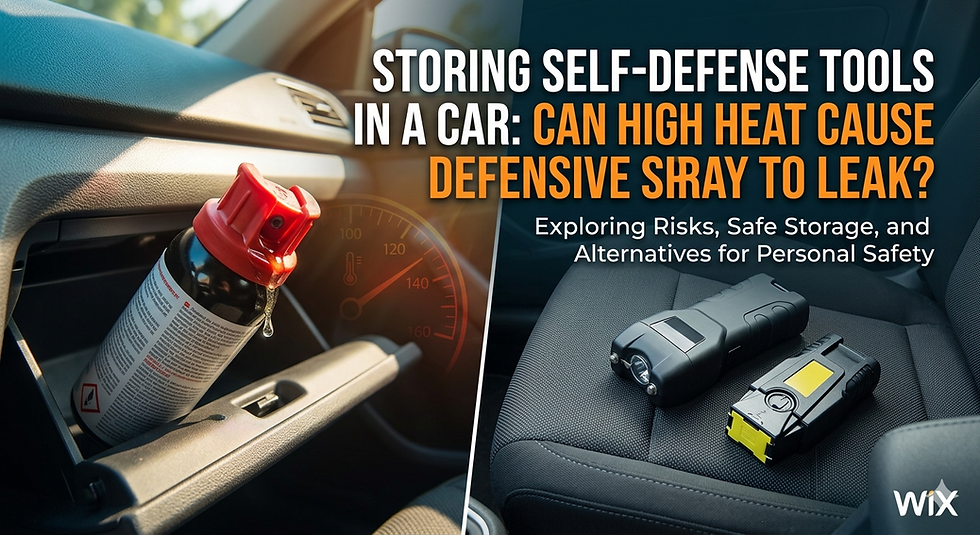
Storing Self-Defense Tools in a Car: Can High Heat Cause Defensive Spray to Leak?
- John Smith
- May 14
- 9 min read

By John Smith | Safety Consultant, Austin, Texas | Stun Gun Defence
If you carry a personal safety spray or a non-lethal safety tool in your vehicle, you've probably wondered at least once: Is it safe to leave these in my car during a hot summer day? It's a fair question and honestly, one that doesn't get nearly enough attention in safety circles.
Living in Texas, I deal with summer temperatures that routinely push past 100°F. Leaving anything inside a parked car here is practically a heat experiment. But for those of us who keep defensive spray in a glove box or a center console, the stakes are more than just a melted candy bar. There are real safety implications to understand.
This article breaks down exactly what happens to defensive spray and other personal protection devices when they're exposed to high vehicle temperatures and what you can do to protect both yourself and the tools you rely on.
Why Vehicle Temperatures Are More Extreme Than You Think
Most people underestimate how hot a parked car actually gets. Ambient outdoor temperatures of 80°F can produce interior cabin temperatures exceeding 130–170°F within an hour especially if the car is parked in direct sunlight with no shade or ventilation.
Here's a quick reference that might surprise you:
Outdoor Temp (°F) | Approx. Interior Car Temp After 1 Hour (°F) |
70°F | ~113°F |
80°F | ~123°F |
90°F | ~138°F |
100°F | ~152°F |
110°F | ~165°F+ |
Source: Studies by the Department of Geosciences at San Francisco State University and the National Highway Traffic Safety Administration.
That dashboard? It can reach 200°F or more. And your glove compartment, while slightly cooler, is far from a safe haven for temperature-sensitive items.
What Is Defensive Spray Made Of And Why Does Heat Matter?
To understand the risk, it helps to know what's inside a canister of personal safety spray.
Most defensive sprays are pressurized aerosol products. The active ingredient typically Oleoresin Capsicum (OC), derived from hot peppers is suspended in a carrier solution (often water, oil, or alcohol-based) and pressurized inside a sealed metal canister using a propellant gas, commonly nitrogen or carbon dioxide.
Here's the critical point: pressurized containers and extreme heat are a dangerous combination.
As temperatures rise inside the canister:
The gas propellant expands.
Internal pressure builds significantly beyond its designed operating range.
The seals around the nozzle and valve can degrade, soften, or fail.
In worst-case scenarios, the canister can leak, rupture, or even discharge accidentally.
The OC compound itself may also degrade over time when exposed to heat cycles, reducing the effectiveness of the spray when you actually need it.
The Real Risks: What Can Actually Happen
Let's be specific about the three categories of risk when you store defensive spray in a hot vehicle.
1. Nozzle Leakage and Slow Seepage
This is the most common scenario. The valve and actuator assembly on a defensive spray canister are designed with rubber O-rings and polymer components. Sustained heat exposure causes these materials to soften and expand, potentially allowing small amounts of OC to seep out.
The result? You open your glove box one afternoon and your nostrils are immediately on fire. The residue can coat everything in the compartment your registration, your insurance card, your spare sunglasses and it doesn't wipe away easily.
2. Canister Deformation or Rupture
In extreme cases especially in vehicles parked for extended periods in desert climates or on asphalt lots with full sun exposure the internal pressure can exceed the structural rating of the canister. While modern defensive spray canisters are built to higher tolerances than many aerosol products, they are not rated for sustained exposure to 150°F+ temperatures.
A rupturing or forcefully discharging canister in an enclosed vehicle is a serious safety incident. The OC concentration in a confined space can cause intense eye, skin, and respiratory distress.
3. Potency Loss and Reliability Degradation
Even if the canister doesn't leak or rupture, repeated heat exposure degrades the propellant and can affect the spray pattern and range. A defensive spray that's been "cooked" in a car repeatedly over summer months may not perform as intended in a real situation. That's a safety failure at the worst possible time.
What About Personal Protection Devices Like Stun Guns and Tasers?
Defensive spray isn't the only thing people store in their vehicles. Non-lethal safety tools including personal protection devices that deliver an electrical deterrent are also commonly kept in glove boxes, center consoles, or door pockets.
Heat affects electronic personal protection devices differently, but the risks are still very real:
Battery degradation: Lithium-ion and NiMH batteries lose charge capacity and can swell or leak electrolyte when exposed to sustained heat above 113°F. A personal protection device with a dead or damaged battery is unreliable when you need it most.
Circuit board damage: The internal electronics in modern stun-type devices can warp or suffer micro-fractures in solder joints due to thermal expansion and contraction cycles.
Plastic housing warping: The grip and housing on personal protection devices can soften, warp, or crack under extreme heat, affecting how the device is held and whether safety mechanisms function correctly.
Capacitor stress: Stun devices use capacitors to store charge. Repeated heat exposure can reduce capacitor efficiency, meaning the device may deliver a weaker deterrent effect over time.
For those exploring what options are currently available and their technical specifications, platforms that list the best stuns in USA typically include detailed product specs around operating temperature ranges and battery chemistry information that's genuinely useful when deciding what to carry and how to store it.
[IMAGE: Close-up of a personal protection device next to a car's glove compartment, illustrating common storage choices for self-defense tools]
Safe Storage Alternatives: What to Do Instead
The good news is that this is an entirely solvable problem. You don't have to choose between having your personal safety tools accessible and keeping them in good condition. You just need to be thoughtful about where and how you store them.
Option 1: Take It With You
The simplest solution is to not leave your personal safety tools in a parked car at all. If you carry a defensive spray on a keychain or in a bag, bring it with you when you exit the vehicle. This isn't just good for the canister it keeps the tool available where it actually matters.
Option 2: Use a Shaded or Insulated Storage Location
If you do need to store your tools in the car, avoid locations that receive direct sunlight:
Avoid: dashboard, top of center console, door pockets exposed to windows, rear window shelf
Better: under the driver's seat, inside the trunk (in a closed storage area), or in a glove box on the passenger side (generally cooler than driver-side areas)
A small insulated pouch or mini cooler bag can reduce temperature fluctuations significantly for items stored in a vehicle.
Option 3: Invest in a Sunshade and Window Tinting
A quality windshield sunshade can reduce interior cabin temperatures by 30–40°F a meaningful difference for everything stored inside, including your personal safety tools. Reflective window tinting provides similar benefits and is a permanent solution for those who live in hot climates.
Option 4: Rotate and Inspect Regularly
If your defensive spray or non-lethal safety tool lives primarily in your vehicle, establish a habit of:
Inspecting the canister every 4–6 weeks for signs of leakage, deformation, or actuator issues
Checking the expiration date (most defensive sprays have a 2–4 year shelf life, which can be shortened by heat exposure)
Testing your personal protection device's charge level and function
Replacing any item that shows signs of heat damage, even if you're not sure it's fully compromised
Option 5: Choose Products Rated for Wider Temperature Ranges
Some manufacturers build defensive sprays and personal protection devices to higher temperature tolerances. When exploring options, look for product documentation that specifies a storage temperature range. A good rating to look for is -20°F to 120°F, though some specialized products go higher.
Legal Considerations When Carrying in Your Vehicle
Laws around carrying defensive sprays and personal protection devices in a vehicle vary significantly by state. Here's a general overview but always verify with your local laws, as regulations change.
Defensive Spray (Pepper Spray) Vehicle Laws General Overview
State | Notes |
Texas | Legal to carry; no permit required; must be pocket-sized |
California | Legal; canister must be under 2.5 oz net weight |
New York | Legal for adults 18+; must be pocket-sized; certain formulations restricted |
Illinois | Legal; must be 18+; size and concentration limits apply |
Michigan | Legal; 2% concentration limit on OC; no more than 35g |
Massachusetts | Requires Firearms ID card; sold only through licensed dealers |
Washington D.C. | Must register defensive spray with MPD |
This table is a general reference only. Always consult your state attorney general's office or a qualified legal professional for current, jurisdiction-specific guidance.
Personal Protection Devices (Stun Guns/Tasers) Vehicle Carry Notes
Many states allow personal protection devices in a vehicle but have restrictions on carrying them concealed on your person without a permit. Some states prohibit them entirely. Always check:
Whether your state allows stun-type devices at all
Whether there are restrictions on having them in a vehicle versus on your person
City or county ordinances that may be stricter than state law
FAQ: Common Questions About Storing Self-Defense Tools in a Car
Q: Can a defensive spray canister explode in a hot car?
While the word "explode" is dramatic, a canister can rupture or forcefully discharge under extreme heat conditions. This is uncommon with well-manufactured products stored in vehicles under typical conditions, but becomes a real risk if a car is parked for extended periods in extreme heat (think 150°F+ interior temps, which occur regularly in Southwestern U.S. states during summer).
Q: How do I know if my defensive spray has been damaged by heat?
Look for these warning signs:
Visible residue around the nozzle tip
A noticeable OC odor when you open the compartment where it's stored
Deformation of the canister (bulging sides or a misshapen actuator)
Reduced pressure when you test-spray (only do this outdoors, away from people)
The canister feels lighter than it should
If you notice any of these, dispose of the canister safely and replace it.
Q: Is it legal to dispose of old defensive spray in the trash?
Generally no pressurized aerosol canisters should be disposed of according to local hazardous waste guidelines. Many municipalities have household hazardous waste (HHW) collection days where you can safely drop off aerosol products. Do not puncture, incinerate, or crush defensive spray canisters.
Q: Can I store my defensive spray in a locked car overnight?
Overnight storage is generally less of a concern than daytime storage in direct sunlight, since temperatures drop significantly. The danger period is when a car sits in the sun for several hours with the windows up. Nighttime storage in a cool, shaded garage is generally fine.
Q: Does cold weather cause problems for defensive spray too?
Yes. Extremely cold temperatures (below -10°F to -20°F) can affect the propellant and reduce spray distance and pattern effectiveness. If you live in a region with harsh winters, bring your defensive spray inside during extreme cold snaps as well.
Q: At what temperature does a defensive spray canister become dangerous?
Most manufacturers rate their products for storage up to 120°F. Vehicle interior temperatures regularly exceed this threshold during summer months in many parts of the United States. Once temperatures exceed the rated storage range consistently, the risk of seal failure and propellant over-pressurization increases meaningfully.
Q: Should I keep my personal protection device charged while stored in the car?
It depends on the device and battery type. For lithium-ion based devices, storing at a partial charge (around 50%) in a cool location is better for long-term battery health than storing at full or zero charge. If your device will sit unused in a vehicle for weeks, remove it and store it indoors if possible.
A Note on Defensive Spray Formulations and Heat Resistance
Not all defensive sprays are created equal. There are several formulations on the market:
OC (Oleoresin Capsicum): Most common; derived from pepper plants; affected by heat cycling over time
CS Gas (2-chlorobenzalmalononitrile): Synthetic irritant; generally more stable chemically but still subject to pressurization risks
CN Gas (Chloroacetophenone): Older formulation; largely replaced by OC in consumer products
OC/CS Combinations: Used in some law enforcement-grade products; no meaningfully better heat resistance than standard OC
Regardless of formulation, the pressurized canister design is the primary heat-related concern — not the chemistry of the active ingredient alone.
Further Reading and Additional Resources
For a deeper dive into this specific topic with additional data points on canister pressure and real-world testing, the team at Bling sting has published a useful resource: heat effects on defensive spray stored in vehicles it's worth a read if you want additional perspective on canister safety and storage practices.
Conclusion: Storage Awareness Is Part of Personal Safety
Choosing to carry a personal safety spray or a non-lethal safety tool is a responsible decision. But that responsibility extends beyond just carrying the item it includes maintaining it properly and storing it in conditions where it will actually function as intended.
The heat inside a parked vehicle is one of the most overlooked threats to the reliability of personal protection devices. A defensive spray that has been repeatedly cooked by summer heat may leak, may have reduced range and output, or in a worst-case scenario, may discharge unexpectedly. A personal protection device with a heat-damaged battery may fail to activate when it matters most.
The fix is genuinely simple:
Take your tools with you when you exit the vehicle whenever possible.
If you must store them in the car, keep them out of direct sunlight in an insulated location.
Inspect your tools regularly and replace anything that shows signs of heat damage.
Know the temperature ratings of the products you carry.
Personal safety is only as strong as the tools you rely on and those tools need to be cared for to remain reliable. A few small habits go a long way toward ensuring your safety gear is ready when you actually need it.
Stay safe, stay informed, and don't let a hot car be the thing that lets you down.
John Smith reviews non-lethal personal protection tools and safety practices at Stun Gun Defence. Based in Austin, Texas, he writes to help everyday people make informed, responsible choices about personal safety.
Tags: defensive spray storage, pepper spray heat safety, personal protection device care, car safety storage, non-lethal safety tools, summer safety tips, OC spray canister safety


Comments