A Guide to Concealed Carry for Women's Self-Defense
- John Smith
- May 16
- 10 min read

By John Smith | Safety Consultant | Austin, Texas
Introduction: The Question More Women Are Asking
A friend of mine a nurse who works late shifts and commutes alone once asked me a question I've heard more times than I can count: "John, what's the smartest way for a woman to carry something for her own safety without drawing attention to herself?"
It's a completely valid question. According to data from the Pew Research Center, women are increasingly prioritizing personal safety, and more than ever, they're taking an active role in their own protection planning. Whether you're a student walking to a parking garage, a professional traveling solo, or a mother juggling a busy life, concealed carry for personal protection is a topic worth understanding thoroughly not from a fear-based perspective, but from an informed, empowered one.
This guide is not about advocating for any particular product or lifestyle. It is about equipping you with accurate, practical, and legally grounded knowledge so you can make decisions that are right for you.
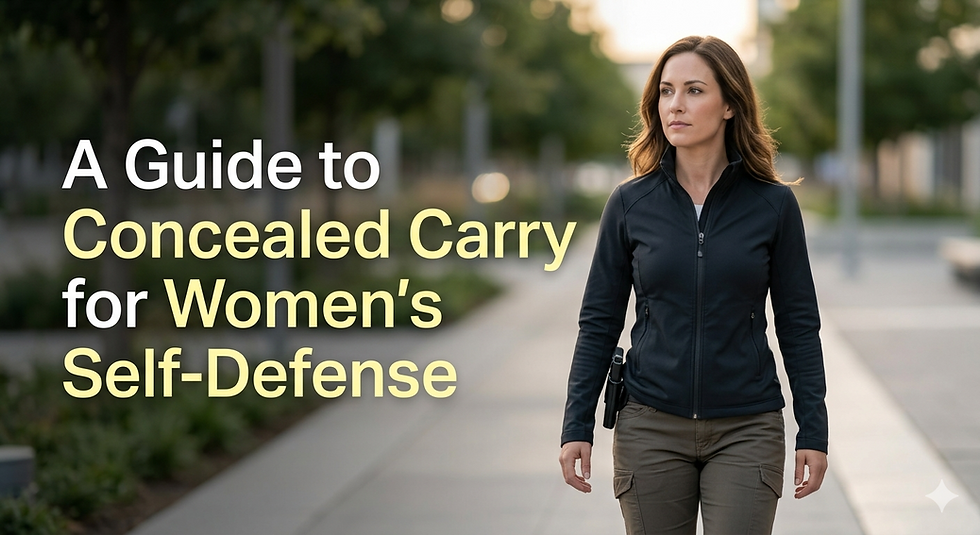
What Does "Concealed Carry" Actually Mean?
When most people hear "concealed carry," they immediately think of firearms. And while that's one interpretation, the concept is much broader it refers to carrying any personal protection device in a discreet, non-visible way. That includes:
Non-lethal safety tools such as personal protection devices (commonly known as stun guns or tasers)
Defensive sprays (such as personal safety sprays or OC sprays)
Tactical utility blades or everyday carry tools
Firearms, for those with the appropriate licensing and training
This guide focuses primarily on the non-firearm options that are legal, widely accessible, and practical for daily carry while also touching on firearms for those exploring that route.
Why Women Have Unique Concealed Carry Needs
Personal safety planning isn't one-size-fits-all, and women often face specific practical challenges that men simply don't:
1. Clothing and Holster Compatibility
Women's clothing tends to have fewer pockets and thinner fabrics, which can make traditional holster setups uncomfortable or impractical. A belt holster designed for men's jeans simply doesn't translate well to a fitted blazer or a dress.
2. Ease of Access Under Pressure
In a stressful situation, muscle memory matters. If a device is difficult to retrieve buried in a bag or awkwardly positioned it provides limited practical protection. Women need carry solutions that allow quick, natural access.
3. Social Stigma and Discretion
Many women feel uncomfortable openly discussing their safety tools, and that's okay. Concealed carry exists precisely so you don't have to broadcast what you're carrying.
4. Physical Considerations
Body composition varies greatly, and some carry positions that work for a larger frame may be uncomfortable for a smaller one. Finding the right fit is genuinely important.
Non-Lethal Safety Tools: A Smart Starting Point
For many women especially those new to personal safety planning a non-lethal safety tool is an excellent first step. These devices can be highly effective deterrents and do not require the same level of licensing, training, or legal compliance as a firearm in most states.
Personal Protection Devices (Stun-Type Tools)
These tools work by temporarily disrupting muscle function through an electrical charge, giving you time to create distance and seek help. They do not cause permanent harm when used appropriately.
Key considerations when evaluating one:
Voltage and amperage: Look at the amperage, not just the voltage. A device with lower voltage but higher amperage can be more effective.
Form factor: Lipstick-style, flashlight-style, and keychain models each serve different lifestyle needs.
Safety mechanisms: A built-in safety switch prevents accidental discharge in your bag.
Charge life: Battery-powered vs. rechargeable designs have different maintenance needs.
For those in the research phase, platforms that specialize in best stuns in USA provide detailed specification breakdowns and usage guidance helpful for understanding what distinguishes one model from another without any pressure to decide immediately.
Defensive Sprays (Personal Safety Sprays)
Personal safety sprays often referred to as pepper spray are one of the most widely carried non-lethal tools in the United States. They work by causing a temporary but intense inflammatory reaction in the eyes and respiratory tract.
What to look for:
OC concentration: Look for sprays in the 1.3%–2% Major Capsaicinoids (MC) range for reliable effectiveness.
Spray pattern: Stream patterns carry farther but require more precision. Fog/cone patterns cover a wider area but can be affected by wind.
Expiration dates: These sprays have a shelf life typically 2–4 years. Replace them on schedule.
Canister size: Keychain models are convenient but hold fewer bursts. Holster-style canisters offer more capacity.
Legal note: Defensive spray is legal in all 50 states, but some states restrict canister size (e.g., Michigan limits to 35 grams), age of purchase (often 18+), and OC concentration. Always verify your state's current laws.
Understanding Concealed Carry Laws by State (Non-Firearm Focus)
[IMAGE: Illustrated map of the United States showing general color-coded tiers of personal protection device regulations by state]
Laws vary significantly from state to state, and even city to city. Here is a general overview but please note this is educational, not legal advice. Always consult your state's official statutes or a local attorney for the most current rules.
Personal Protection Devices (Stun-Type)
State Category | Description | Example States |
Fully Legal | Adults can carry without restrictions | Texas, Florida, Colorado, Nevada |
Restricted (Age/Location) | Legal but with specific age or location limits | California (no felony history), Illinois (21+) |
Permit Required | Need a license to carry | Some municipalities in Wisconsin |
Restricted or Banned | Prohibited or very limited use | Hawaii, Rhode Island (check current status) |
Always double-check: Laws change. Before carrying any device, verify with your state's current statutes. NCSL (National Conference of State Legislatures) maintains updated databases.
Firearms: Concealed Carry Permits for Women
If you're exploring concealed carry of a firearm, the landscape is more complex. As of 2024, the majority of U.S. states have adopted some form of "shall-issue" or constitutional carry:
Constitutional Carry (Permitless Carry): Currently adopted by more than 25 states, meaning eligible adults can carry without a permit. Texas joined this group in 2021.
Shall-Issue States: Authorities must issue a permit if you meet the requirements (background check, training).
May-Issue States: Authorities have discretion, and permits may be harder to obtain. California and New York historically fall here, though laws are evolving post-Bruen (2022 Supreme Court ruling).
What's typically required to obtain a firearm carry permit:
Minimum age (usually 21 for CCW, 18 for open carry in some states)
Clean background check
Completion of an approved safety course
Application and fee submission
Fingerprinting in some states
Choosing the Right Carry Method for Your Lifestyle
One of the most practical questions any woman can ask is: "Where and how will I actually carry this?" Here are the most common methods, with honest pros and cons for each.
Purse Carry
Pros: Natural to most women's existing habits; accessible; works with any outfit.
Cons: Bags get set down, stolen, or left behind. Access under stress can be slow. Children or others may reach into your bag.
Best practice: If you carry in a purse, use a bag with a dedicated, zippered inner compartment specifically for your safety tool and practice retrieving it with your eyes closed.
Holster Carry (Inside Waistband / Appendix)
Pros: Fastest access; most secure; hardest to take from you.
Cons: Requires compatible clothing; can be uncomfortable for smaller frames; requires consistent practice.
Best for: Women who wear jeans, leggings with a waistband, or clothing that supports a discreet holster clip.
Bra Holsters
Pros: Works under many outfit types; extremely discreet.
Cons: Slower access; potential for discomfort with prolonged wear; not suitable for all body types or device sizes.
Thigh / Ankle Holsters
Pros: Excellent for skirts, dresses, and formal wear.
Cons: Typically the slowest access point; may shift during the day; limited to smaller devices.
Keychain Carry
Pros: Always with you; no additional thought required; available for many device types.
Cons: Works only for keychain-sized tools; limited capacity.
John's take: There's no universally "best" method. The best carry method is the one you'll actually use consistently and the one that lets you access your tool quickly if you ever need to.
Training and Practice: The Part Most People Skip
Carrying any personal protection device lethal or non-lethal without practice is a bit like keeping a fire extinguisher in your home without knowing how to use it. The device may be there, but the confidence and muscle memory won't be.
For Non-Lethal Safety Tools:
Read the manual thoroughly and understand the safety mechanisms.
Practice the draw from your specific carry position slowly, repeatedly, until it feels natural.
Know the range and effective distance of your specific tool.
Understand how to hold and activate it without looking directly at it.
For Defensive Sprays:
Understand your specific spray pattern (stream vs. cone vs. gel).
Practice the motion of retrieving and uncapping under mild pressure.
Know how to position yourself relative to wind.
Be aware of how cross-contamination can affect you as the user.
For Firearms:
Formal instruction is non-negotiable. Look for NRA Basic Pistol courses, USCCA training, or local women-specific firearms instruction (like "A Girl & A Gun" chapters, which operate nationally).
Dry-fire practice at home builds trigger discipline without requiring range time.
Live-fire practice at least monthly is a reasonable maintenance baseline.
Situational awareness training is just as important as marksmanship.
The Role of Situational Awareness (Your First Line of Defense)
No device replaces awareness. Every personal safety instructor worth their credentials will tell you the same thing: avoidance is always preferable to confrontation.
Situational awareness basics:
Scan your environment before entering: Parking garages, stairwells, and isolated areas deserve a visual check before you commit to entering.
Trust your instincts: If something feels off, it probably is. Your intuition is processing environmental data faster than your conscious mind.
Limit distractions in public: Headphones in, eyes on your phone these reduce your awareness bubble significantly.
Know your exits: In any new environment, a quick mental note of exits and alternative routes is a smart habit.
Walk with intent: Confident posture and purposeful movement signal awareness.
Vary your routines: Predictable schedules and routes make you easier to anticipate.
Situational awareness isn't about paranoia it's about being present.
Frequently Asked Questions
Q: Is it legal for a woman to carry a personal protection device in all 50 states?
A: Not universally. Personal protection devices (stun-type tools) are restricted or outright banned in a handful of states and certain municipalities. Defensive sprays are legal nationwide but with varying restrictions on canister size and strength. Always verify your specific state and local laws before carrying anything.
Q: Do I need a permit to carry a non-lethal tool?
A: In most states, no permit is required for non-lethal personal protection devices. However, some states have age requirements (typically 18+), and individuals with certain criminal histories may be prohibited from possessing them.
Q: What if I've never carried anything before where do I start?
A: Start with research and legal review. Understand what's permitted in your state. Then consider a defensive spray as an entry-level option they're inexpensive, legal in all 50 states (with caveats), and require minimal training. From there, you can assess whether a stun-type tool or firearm suits your lifestyle and comfort level.
Q: Can I carry on a plane?
A: Firearms may be checked (unloaded, in a locked hard case) with TSA notification, but may never be carried in carry-on luggage. Most defensive sprays and personal protection devices are prohibited entirely in both carry-on and checked baggage. Review TSA and airline guidelines before traveling.
Q: I live in an apartment and travel for work what's the most versatile setup?
A: A combination approach works well for many women: a defensive spray for everyday carry (highly portable, no licensing) and a personal protection device for home and travel situations where it's legally permitted. Research the laws of your destination before traveling with any device.
Q: How do I explain my carry to a partner or family who's skeptical?
A: Frame it around education, not fear. Share statistics about crime prevention and deterrence. Emphasize that carrying a non-lethal tool doesn't mean you're expecting danger it means you're prepared in the same way you carry insurance or keep a first aid kit. Knowledge reduces anxiety, for both you and them.
Building a Personal Safety Plan: A Holistic Approach
Concealed carry is one component of a broader personal safety framework. A well-rounded plan includes:
Home security: Solid locks, door reinforcement, a reliable alarm system, and good exterior lighting.
Digital safety: Protecting your location data and online privacy reduces the risk of targeted situations.
Emergency contacts: Have a designated person who knows your schedule and can act quickly if something's off.
Communication tools: A fully charged phone, emergency SOS features enabled, and ICE (In Case of Emergency) contacts saved.
First aid basics: Knowing how to respond to injuries your own or others' is a foundational safety skill.
Personal safety is a mindset and a set of habits not just a device you carry.
A Note on Women-Specific Resources
The concealed carry community has grown significantly more inclusive over the past decade, with strong women-led organizations and platforms dedicated specifically to women's safety education:
The Well Armed Woman a national organization with local chapters for women interested in firearms safety
A Girl & A Gun community-based training events across the country
USCCA (U.S. Concealed Carry Association) training, legal resources, and insurance for responsible carriers
For an in-depth, beginner-oriented breakdown of what concealed carry looks like from a woman's perspective including practical gear recommendations and state-by-state considerations women's concealed carry beginner's guide at Pew Pew Mom offers a thorough, experience-based resource worth bookmarking.
Conclusion: Empowerment Through Education
The best thing about personal safety is that it starts with a decision the decision to take it seriously and learn your options. You don't need to be an expert from day one. You just need to be willing to ask questions, do the research, and take small, consistent steps toward being prepared.
Here's a quick summary of the key takeaways from this guide:
Concealed carry is broader than firearms it includes non-lethal tools that are accessible to most adults.
Laws vary by state always verify local regulations before carrying anything.
Carry method matters the "best" option is the one that fits your lifestyle and allows reliable access.
Training is non-negotiable even the best tool is limited without practice.
Situational awareness remains your first line of defense no device replaces paying attention.
A holistic safety plan is more powerful than any single tool.
Stay informed. Stay prepared. And most importantly stay safe.
John Smith reviews non-lethal personal protection tools and covers personal safety education at Stun Gun Defence. He is based in Austin, Texas, and writes as an independent safety consultant with no commercial affiliation.
Disclaimer: This article is intended for educational purposes only and does not constitute legal advice. Laws governing the carry of personal protection devices vary by jurisdiction and change over time. Always consult current state and local statutes or a licensed attorney before making decisions about what you carry.


Comments